
EPR packaging deadline May 31: What CPG Brands must know?

You didn't wake up thinking about EPR. But if you're a CPG brand selling in California, Colorado, Oregon, Minnesota, Maryland, or Washington, you need to report your 2025 packaging data by May 31, 2026, or face fines, sales restrictions, and potentially being listed on Oregon's public noncompliance registry.
This isn't policy talk anymore. It's operational. EPR fees are now eco-modulated—meaning your packaging design choices directly determine your compliance costs. Hard-to-recycle materials cost more. And with California's SB 343 restricting what you can claim as "recyclable" on your label, one mistake hits you twice: higher fees and labeling penalties.
But you can stay compliant without the scramble. This guide shows you exactly what the May 31 deadline requires, which states are active, how fees are calculated, and the step-by-step action plan to avoid penalties while protecting your margins.
Let's get your brand ready, before the deadline hits.
What the May 31 EPR deadline actually requires?

Extended Producer Responsibility is not a new concept in Europe, but for U.S. CPG brands, 2026 marks the year it stops being a policy discussion and becomes an operational reality.
May 31, 2026 is the first common reporting deadline established by the Circular Action Alliance (CAA), the national PRO administering multi-state EPR programs for California, Colorado, Oregon, Minnesota, Maryland, and Washington.
By this date, brands must submit 2025 packaging data — covering material types, weights, and volumes introduced to market — which the CAA will use to calculate producer fees for each participating state program.
If your brand name appears on a package you sell in the United States, you are almost certainly classified as a "producer" under these laws. That classification triggers registration, reporting, and fee obligations — and ignoring any one of them exposes you to fines, sales restrictions, and enforcement actions that are no longer theoretical.
According to the published legal analysis, EPR implementation is ramping up dramatically this year. The pattern across states is consistent: registration requirements that were once voluntary or low-stakes are now tied to active fee collection and regulatory oversight. What changes in 2026 is accountability. Audits, penalties, and enforcement mechanisms are operational.
In Practice: Many compliance teams assume EPR only applies to their primary packaging — the container the consumer holds. In practice, most state laws cover secondary and tertiary packaging too, including shipping cases, pallets, and inner wrapping materials. If your team is only tracking retail unit packaging, you are likely underreporting your covered material weight, which creates both fee miscalculation risk and potential audit exposure.
Essential EPR Resources for CPG Brand Owners
Keep this table handy. These are the official resources, laws, and deadlines every CPG brand owner and brand manager needs to know to stay compliant before May 31, 2026.
| Resource | What It Is | Who Needs It | Link |
|---|---|---|---|
| Circular Action Alliance (CAA) Producer Reporting | Official reporting portal for 2025 packaging data across 6 states | All producers selling in CA, CO, OR, MN, MD, WA | https://circularactionalliance.org/producer-reporting circularactionalliance |
| CAA Producer Resource Center | EPR guidance, FAQs, and state-specific requirements | CPG brands new to EPR compliance | https://circularactionalliance.org/producer-resource-center circularactionalliance |
| California SB 54 EPR Program | Official CalRecycle EPR regulations & deadlines | Brands selling in California | https://calrecycle.ca.gov/packaging/packaging-epr/ calrecycle.ca |
| California SB 343 Truth in Labeling Law | Recyclability claim restrictions (60% population threshold) | Brands making "recyclable" claims in California | https://www.nixonpeabody.com/insights/alerts/2026/04/06/californias-sb-343-restricts-common-recyclability-claims-on-products-and nixonpeabody |
| Maine EPR Stewardship Program | Official Maine DEP EPR requirements & reporting | Brands selling in Maine | https://www.maine.gov/dep/waste/recycle/epr.html maine |
| Colorado Packaging EPR Program | HB 22-1355 program details & fee structure | Brands selling in Colorado | https://erp-recycling.org/news-and-events/2025/12/colorado-packaging-epr-program-set-for-2026-launch/ erp-recycling |
| EcoEnclose EPR Guide | 2026 comprehensive EPR packaging requirements guide | CPG teams needing practical implementation guidance | https://www.ecoenclose.com/resources/epr-packaging-requirements ecoenclose |
| Venable LLP EPR Analysis | March 2026 legal analysis on EPR ramp-up & compliance | Legal counsel & compliance teams | https://www.venable.com/insights/publications/2026/03/cpg-brands-meet-your-new-p-and-l-line-item venable |
| Alston & Bird EPR Deadline Guide | May 31, 2026 reporting deadline details & state breakdown | All CPG brands facing May 31 deadline | https://www.alston.com/en/insights/publications/2026/05/packaging-epr-reports-due-may-31 alston |
| State-by-State EPR Overview (Trayak) | 2026 state EPR regulations comparison & timelines | Brands operating in multiple states | https://trayak.com/state-by-state-overview-2026-epr-regulations/ trayak |
| Maryland EPR Packaging Law (SB 901) | Maryland-specific EPR requirements & exemptions | Brands selling in Maryland | https://www.berlinpackaging.com/insights/sustainability/maryland-enacts-epr-packaging-law berlinpackaging |
| FDA Food Labeling Guide | 21 CFR Part 101 food labeling requirements | All CPG brands with food products | https://www.fda.gov/regulatory-information/search-fda-guidance-documents/guidance-industry-food-labeling-guide fda |
Quick Reference: State Deadlines at a Glance
| State | 2026 Deadline | Report Type |
|---|---|---|
| California | May 31, 2026 (June 1 extended) | Annual Supply Report + Source Reduction Report alston |
| Colorado | May 31, 2026 | Annual Supply Report alston |
| Oregon | May 31, 2026 | Annual Supply Report alston |
| Maryland | May 31, 2026 (simplified); July 1, 2026 (PRO registration) | Simplified Supply Report alston |
| Minnesota | May 31, 2026 | Simplified Supply Report alston |
| Washington | May 31, 2026 (simplified); July 1, 2026 (PRO registration) | Simplified Supply Report alston |
| Maine | Q3 2026 (TBD) | Annual Report rev-log |
Which states are active and what their rules differ on?
Seven states have passed EPR packaging laws that are either in effect or moving into active enforcement: California, Colorado, Maine, Maryland, Minnesota, Oregon, and Washington. Each has its own reporting categories, material definitions, threshold exemptions, and calendar of registration and fee cycles. This is not a federal program with a single rulebook — it is a patchwork of state-level obligations that your compliance team must track individually.
State-by-state breakdown:
Here is what diverges most significantly across state programs:
| State | Law | Key Deadline 2026 | Status |
|---|---|---|---|
| California | SB 54 (Plastic Pollution Prevention and Packaging Producer Responsibility Act) | May 31, 2026 (annual + baseline supply reports); June 1, 2026 (extended) | Regulations approved May 1, 2026 linkedin+1 |
| Colorado | HB 22-1355 | May 31, 2026 (annual supply report) | Fee program active alston+1 |
| Oregon | SB 582 (Plastic Pollution and Recycling Modernization Act) | May 31, 2026 (annual supply report) | Program launched July 1, 2025 proskauer+1 |
| Maryland | SB 901 (Packaging Producer Responsibility Act) | May 31, 2026 (simplified report); July 1, 2026 (PRO registration) | PRO registration begins 2026 alston+1 |
| Minnesota | HF 3911 / SF 3877 | May 31, 2026 (simplified report) | Stewardship plans due Oct 1, 2028 alston+1 |
| Washington | SB 5284 | May 31, 2026 (simplified report); July 1, 2026 (PRO registration) | PRO registration by July 1, 2026 alston+1 |
| Maine | LD 1541 | Q3 2026 (TBD) | Operational 2027 foodnavigator-usa+1 |
Material definitions and thresholds
What counts as "covered packaging" varies. Some states define thresholds by revenue or volume of packaging introduced to market, which means a brand that qualifies as a producer in California may fall below the threshold in Oregon. You cannot assume your California registration satisfies your Oregon obligations.
Fee structures and eco-modulation
Every active EPR state ties producer fees to the environmental characteristics of the packaging material. High recycled content earns discounts. Low recyclability triggers surcharges. But the specific modulation schedules differ — California's fee model is not the same as Colorado's. Your packaging materials team needs to model fee exposure under each state's formula separately.
Reporting formats and deadlines
As Venable LLP noted in their March 2026 analysis, building a standardized internal data set and then translating it into each state's format is not optional — it is the only way to avoid recreating work and introducing inconsistencies across submissions. Each state has its own reporting template, and submitting data in the wrong format is treated as a reporting failure.
Report types required:
- Annual Supply Report (California, Colorado, Oregon): 2025 supply data on total weight of covered material, broken down by state-specific material categories
- Simplified Supply Report (Maryland, Minnesota, Washington): 2025 data using 8 broad material categories (printing/writing paper, metal, rigid plastic, wood/other, glass/ceramics, paper/fiber, flexible plastic, compostable)
- Source Reduction Report (California): Required by May 31, 2026, measuring plastic reduction relative to 2023 baseline
Maryland's upcoming requirements
Under Maryland's EPR law (SB 901), PROs must submit a registration form listing producer company names, brands, and covered packaging materials by July 1, 2026, with annual updates thereafter. A five-year producer responsibility plan is due by July 1, 2028. Maryland's law also requires a needs assessment by December 31, 2026, that will establish baselines for waste reduction, collection rates, recycling rates, and post-consumer recycled (PCR) content usage. Performance targets follow in the stewardship plan due October 1, 2028. Note that Maryland exempts infant formula, medical foods and equipment, drug and medical device packaging, and fortified oral nutrient supplements required for medical purposes.
In Practice: The most common compliance error teams make right now is registering with the CAA as if that satisfies all state obligations. The CAA is a coordinating body for multi-state data collection — it does not replace state-level PRO registration. You must confirm your producer status and register directly with each state PRO where you are required to participate. Legal counsel familiar with each state's specific law is not optional at this stage.
How EPR fees are calculated and why packaging design is now a cost lever?

EPR fees are not flat rates applied uniformly across your portfolio. They are eco-modulated, meaning the material composition, recyclability, and recycled content of each packaging component determines what you pay. This is the mechanism that makes EPR a design incentive, not just a compliance tax.
Under programs like Maryland's, producers pay more for covered materials with low recycled content and receive discounted payments for those with high recycled content. California's program links fee rates to whether packaging meets recyclability standards under SB 343, packaging that cannot be labeled as recyclable under California's rules is effectively penalized twice: once through higher EPR fees, and again through labeling restrictions that limit what you can claim on-pack.
Think of it this way: EPR transforms your packaging material choices into a P&L variable. A packaging engineer choosing between two film structures — one with 30% PCR content and one without — is now making a decision that affects both your fee liability and your labeling options. That connection between material specification and compliance cost is new for most CPG finance and operations teams.
According to analysis from EcoEnclose published in May 2026, brands that delay packaging redesign face a compounding problem: scrambling to update materials after regulations take effect means rushed supplier negotiations, limited availability of compliant materials, higher unit costs, and operational disruption — on top of higher EPR fees for the hard-to-recycle materials they are still using.
The practical implication is that your EPR compliance strategy and your sustainable packaging roadmap are now the same document. Teams that treat them separately will pay more and move slower.
The intersection of EPR and packaging labeling compliance
EPR does not exist in isolation. It is increasingly layered on top of recycling labeling laws that directly affect what you can print on your packaging — and getting those claims wrong creates brand risk that goes beyond EPR fees.
California's SB 343 Truth in Labeling Law
California's SB 343 is the clearest example. It restricts when and how brands can use recyclability claims on packaging. A recyclability claim is considered deceptive or misleading unless the product or packaging meets all three criteria:
- Materials must be collected by recycling programs serving at least 60% of California's population
- Sorted into defined streams by large volume transfer or processing facilities serving at least 60% of recycling programs statewide
- Sent to a reclaimer consistent with the Basel Convention
If your material is not collected, sorted, and recycled at sufficient scale in California, you cannot call it recyclable on the label, regardless of what the resin code says. This intersects directly with EPR because your packaging's recyclability status under SB 343 also affects your fee tier under California's EPR program.
A step-by-step EPR compliance action plan for CPG teams
The May 31 deadline is immediate, but EPR compliance is an ongoing operational discipline, not a one-time filing. Here is a structured action plan for CPG compliance and regulatory affairs teams.
Step 1: Confirm your producer status in each active EPR state
Do not assume your company's legal structure or revenue size automatically exempts you. Review the specific definition of "producer" under each state's law and confirm whether your brand qualifies. Engage legal counsel with state-specific EPR experience. The Baker Donelson countdown analysis recommends working closely with legal counsel to determine whether products fall within the scope of "covered materials" and whether any exemptions apply.
Step 2: Register with each required PRO before the deadline
Registration is not the same as the CAA data submission. If your state requires enrollment with a designated PRO, that enrollment must be completed separately. Missing registration is a compliance failure independent of whether you submit data on time.
Step 3: Build a centralized packaging material inventory
For every SKU you sell, document each packaging component (primary, secondary, tertiary), its material type, its weight, and its recyclability status under each relevant state program. This is the data foundation for both your CAA reporting and your fee calculations. Without it, you cannot submit accurate data — and inaccurate reporting creates retroactive liability.
Step 4: Model your fee exposure by state
Using each state's eco-modulation schedule, calculate your expected fee liability under current packaging specifications. Then model what your fees would be if you substituted higher-recycled-content or more recyclable materials. This analysis directly informs your sustainable packaging investment decisions.
Step 5: Audit your on-pack recyclability claims
For every label that carries a recyclability claim, verify that the claim is accurate under the law of each state where the product is sold. California's SB 343 is the most restrictive benchmark — if your claim passes SB 343 scrutiny, it is likely defensible in most other states. If it does not, update the label before enforcement actions begin.
Step 6: Establish a repeatable reporting workflow
EPR reporting is annual. Build the data collection, review, and submission process as a repeatable workflow now, so that next year's cycle does not require the same scramble. This includes assigning ownership, defining data sources, setting internal deadlines ahead of state deadlines, and documenting your methodology for audit purposes.
How Packaging Compliance Platforms Support EPR Readiness?
Managing this complex data footprint across disconnected spreadsheets and email chains creates severe human error risks. GoVisually’s Compliance Suite transitions teams from manual review to automated assurance.
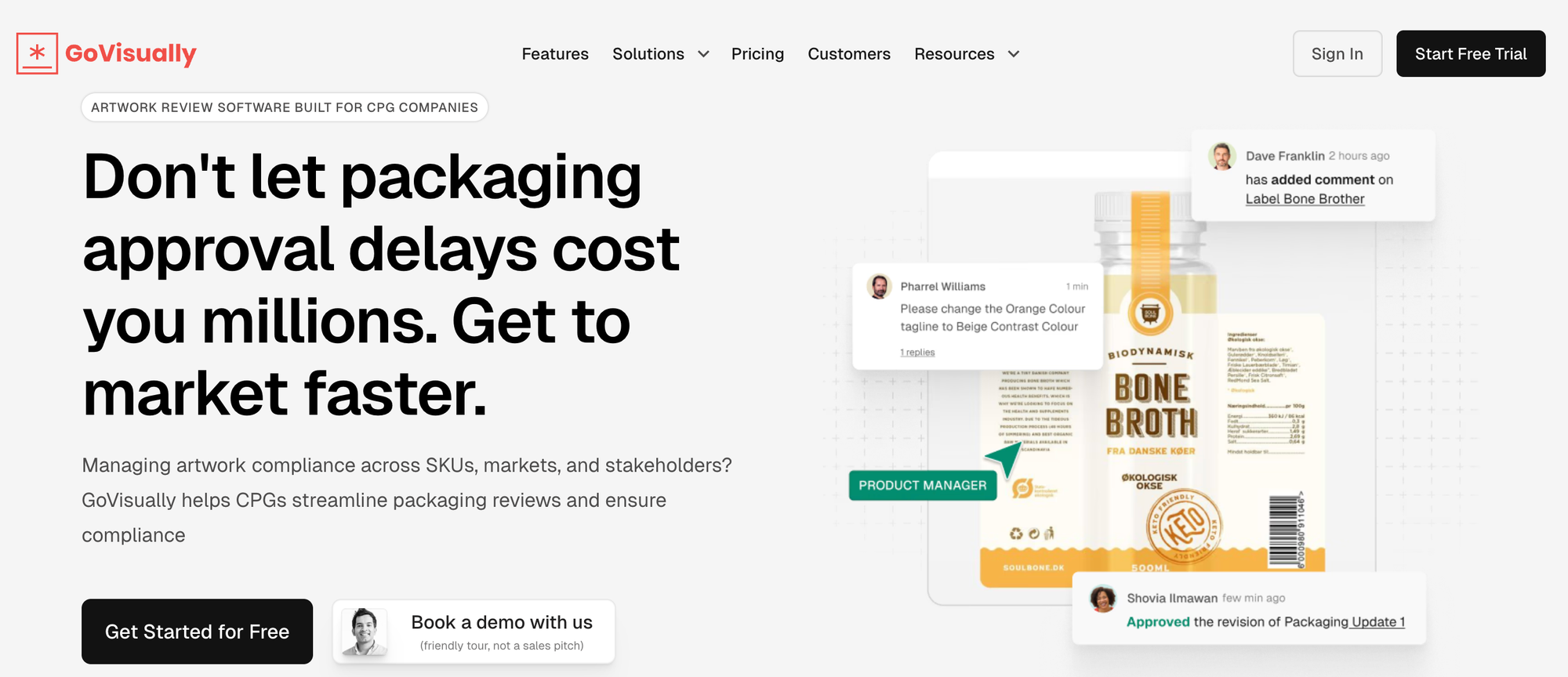
CPG brands using GoVisually’s automated artwork and label compliance workflows see measurable operational improvements:
- 75% Reduction in Review Times: Shifting from manual, cross-referencing text checks to automated verification cuts packaging review cycles from 8 hours down to 2 hours per SKU.
- 80% Faster Artwork Approvals: Brands like NutraBio accelerated time-to-market by automating complex label approval chains and eliminating late-stage design modifications.
- 60% Fewer Revision Rounds: Creative and compliance teams work out of a unified environment, catching claim, symbol, and regulatory errors before files reach production.
- Near-Zero Human Error Rates: Moving away from fatigued human proofreading drops structural and labeling error rates from a standard 1–3% down to near zero.
GoVisually's Dynamic Compliance Auditor automatically flags sustainability and recyclability claims against current state thresholds in under 30 seconds, generating an ironclad, timestamped audit trail ready for state regulators.
Stop treating EPR as an annual scramble. Integrate your data, automate your label reviews, and protect your margins.
FAQ
What is EPR packaging compliance?
EPR (Extended Producer Responsibility) packaging compliance requires brands to track, report, and pay fees on all packaging materials introduced to a market to fund their collection, recycling, and end-of-life processing.
What is EPR in compliance?
In compliance, EPR is a regulatory strategy that holds producers financially and operationally responsible for the entire lifecycle of their products, particularly shifting the cost of waste management from municipalities to the brands themselves.
What are EPR packages?
"EPR packages" refers to any primary, secondary, or tertiary packaging materials—such as retail boxes, shipping containers, pallets, and plastic wraps—that are legally covered under state-mandated environmental reporting and fee structures.
Which EPR materials are most used in the USA?
Corrugated cardboard and flexible plastics (like films and wraps) are the most widely used packaging materials by volume in the US market, and both face intense regulatory scrutiny under upcoming eco-modulated fee formulas.
Who is eligible for an EPR certificate?
Any company that manufactures, imports, or sells products under their brand name that generate regulated waste (like plastic packaging, electronics, batteries, or tires) is eligible and legally required to register. Additionally, authorized waste recyclers and processors are eligible to generate these certificates by verifying the metric tonnage of waste they have responsibly processed.
Conclusion
The May 31, 2026 deadline is the exact moment U.S. packaging sustainability regulation transitions from a policy commitment to a permanent operational requirement. Meeting this deadline is your immediate priority, but navigating EPR successfully requires moving away from the annual scramble entirely.
By centralizing your packaging material data, establishing repeatable reporting workflows, and integrating compliance tools early into your design process, you protect both your brand's reputation and its P&L. The connection between your material specifications and your compliance costs is now direct and quantifiable, and the brands that automate this data loop today will be the ones protecting their margins tomorrow.

Schedule a free demo to see GoVisually's AI Playbooks handle your specific compliance workflow.