
Selling Australian Food Products in the US: The Label Conversion Checklist
A FSANZ-compliant label is not an FDA-compliant label. The 10-point conversion: NIP to Nutrition Facts, Big 9 allergens, dual units, FDA claims and the import controls beyond the label.
Last updated: 17 July 2026 · General information, not legal advice. Verify against FDA regulations (21 CFR 101) or with a US regulatory consultant before printing.
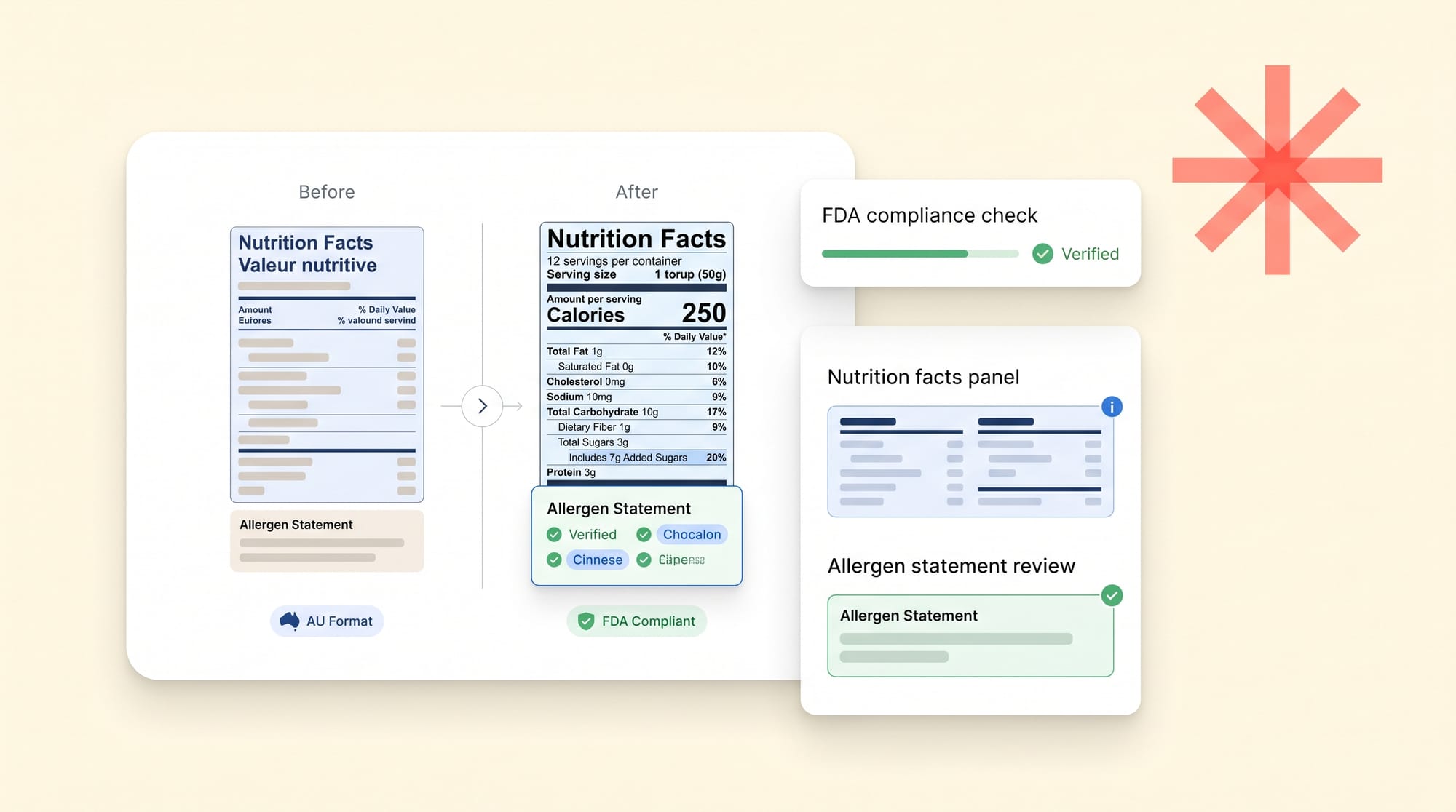
To sell Australian food products in the United States, the label must be rebuilt for FDA rules: the Nutrition Information Panel becomes a Nutrition Facts panel (per serving, in calories, with added sugars), allergens follow the US “Big 9” with a Contains statement, net quantity needs dual US-customary and metric units, dates flip to month/day, and every claim must be re-checked against FDA definitions. A FSANZ-compliant label is not an FDA-compliant label.
Who regulates food labels in the United States?
Most packaged food labels are regulated by the FDA under 21 CFR Part 101; meat, poultry and some egg products fall under USDA-FSIS instead, with its own approval regime. Alcohol sits with the TTB. State rules add requirements — most famously California’s Prop 65 warnings and the new SB 343 recyclability rules for claims.
The 10-point label conversion checklist
1. NIP → Nutrition Facts panel
The Australian per-100g NIP is not acceptable in the US. The FDA panel is per serving, with calories displayed large, using FDA-defined serving sizes (RACCs) — you don’t choose your own. Mandatory lines include added sugars, dietary fibre, vitamin D, calcium, iron and potassium with % Daily Values. Dual-column formats apply to packages that could be consumed in one sitting.
2. Allergens → the US “Big 9”
US law (FALCPA plus the FASTER Act) requires declaration of nine allergens: milk, egg, fish, crustacean shellfish, tree nuts, peanuts, wheat, soybeans and — since 2023 — sesame. Declare via a “Contains” statement or parenthetically in the ingredient list, naming the specific fish, crustacean or tree nut. Differences from PEAL: lupin and molluscs are not mandatory US allergens, sulphites are handled as an ingredient declaration (≥10 ppm), and bolding is not required — but the specific source names are.
3. Net quantity: dual units, prescribed placement
The FPLA requires net contents in both US customary and metric (“NET WT 12 OZ (340 g)”), placed in the bottom 30% of the principal display panel in minimum type sizes tied to package size. Metric-only Australian declarations must be converted.
4. Dates: month/day/year
Australia’s day/month order reads wrong to US consumers and retailers. Federal law doesn’t mandate date marking on most foods (infant formula excepted), but if you carry a date, use US conventions — and note state rules vary for some categories.
5. Ingredient list conventions
Descending order by weight, as at home — but additives use common or usual names, not class-plus-number: “Colour (160b)” becomes “annatto extract (color)”. Characterising-ingredient percentages are not required. Compound ingredients must be broken out unless exempt.
6. Statement of identity and US firm address
The product’s common name goes on the principal display panel, and the label must carry the name and address of the US manufacturer, packer or distributor — typically “Distributed by [your US importer], City, State, ZIP”. An Australian address alone doesn’t satisfy the rule.
7. Country of origin
Imported products must be marked with country of origin under customs rules (“Product of Australia”) — conspicuous and legible. USDA COOL applies to certain commodities at retail.
8. Claims: FDA definitions, not FSANZ
Nutrient content claims (“low fat”, “good source of”) have precise FDA definitions that differ from Standard 1.2.7 thresholds. Health claims must be FDA-authorised or qualified; structure/function claims are allowed but carry their own rules. And front-of-pack elements like the Health Star Rating have no US status — review whether they mislead in the US context, and plan for the FDA’s incoming front-of-pack Nutrition Info box rule.
9. Fortification and ingredient permissions
US food additive and fortification rules (GRAS, food additive regulations) differ from Standard 1.3.1/1.3.2. Some Australian formulations — and some permitted additives — need review or reformulation for the US market. Check before artwork, not after.
10. Beyond the label: registration and import controls
Label compliance won’t clear customs alone: your facility must be FDA-registered (Bioterrorism Act), shipments need prior notice, and your US importer carries FSVP obligations verifying your food safety controls. Build these into the launch plan alongside the artwork.
Australia vs US: the quick comparison
| Element | Australia (FSANZ) | United States (FDA) |
|---|---|---|
| Nutrition panel | NIP, per serving + per 100g, kilojoules | Nutrition Facts, per RACC serving, calories, added sugars, %DV |
| Allergens | PEAL: bold, plain-English + Contains; incl. lupin, sulphites, molluscs | Big 9 incl. sesame; Contains statement; specific nut/fish names |
| Units | Metric only | Dual: US customary + metric |
| Date order | Day/month/year | Month/day/year |
| Additives | Class name + code number | Common or usual name |
| Characterising ingredient % | Required | Not required |
| Address on pack | AU/NZ supplier address | US manufacturer/packer/distributor |
| Claims regime | Standard 1.2.7 pre-approved | FDA-defined content claims; authorised/qualified health claims |
| Front of pack | Health Star Rating (voluntary) | FDA Nutrition Info box rule incoming |
Frequently asked questions
Can I sticker my Australian label for the US market?
Over-stickering can work for pilots if the sticker delivers every mandatory element in the prescribed places and type sizes — but the FPLA’s placement rules (net quantity in the bottom 30% of the display panel) make compliant stickers harder than in Australia. Ranged retail products should plan for printed US artwork.
Does the US require bilingual labelling?
No — English is required. If you add another language anywhere on the pack, mandatory information generally must appear in that language too.
Is my product FDA or USDA?
Most packaged foods are FDA. Products with more than trace meat or poultry content fall under USDA-FSIS, which has its own labelling approval process — establishing which regime applies is step zero.
What about California?
State rules ride on top of federal: Prop 65 warnings for listed substances and SB 343 restrictions on recyclability claims are the two that most often catch imported products.
Converting a range for the US launch?
This conversion is exactly what GoVisually’s AI label compliance suite checks as a first pass — artwork against FDA and FSANZ rules side by side, your team making every call on an audit trail. Deeper reading: the FDA & USDA 2026 compliance guide, the FDA front-of-pack rule guide, and the free nutrition label generator for FDA-format panels.