
Food Label Compliance Guide 2026: FDA & USDA Requirements Every Brand Should Know


Disclaimer: While GoVisually strives to convey accurate information, please refer to the official website of FDA for the most up-to-date guidelines on food and safety and labeling.
In the CPG industry, a product’s journey from concept to consumer is fraught with regulatory complexities. The US food labeling landscape, governed primarily by the FDA and USDA, is a minefield of intricate rules, technical specifications, and ever-evolving mandates.
For brands, navigating this labyrinth manually isn't just slow; it's a direct invitation to costly recalls, fines, and irreparable damage to consumer trust.
This guide cuts through the jargon, providing a clear, actionable overview of the essential US food labeling regulations for 2026. More importantly, it highlights how modern AI-powered solutions, like GoVisually AI, are transforming compliance from a bottleneck into a competitive advantage, ensuring your products not only meet the law but also hit the market with unparalleled speed and certainty.
1. The Cost of Being Wrong: Why Labeling Is Your Brand’s Biggest Risk
Every year, CPG brands face millions in losses due to avoidable labeling errors. A misplaced comma, an incorrect font size, or a forgotten allergen declaration can trigger a cascade of consequences: regulatory penalties, product recalls, and a tarnished reputation. In 2026, the stakes are higher than ever, with increased scrutiny and evolving requirements. Understanding these regulations isn't just about avoiding fines; it's about safeguarding your brand's future and accelerating your path to market.
2. The FDA Blueprint: Navigating the Mandatory "Must-Haves"
The Food and Drug Administration (FDA) sets the foundational rules for most packaged foods in the US. These regulations, primarily outlined in 21 CFR Part 101, ensure consumers receive accurate and essential information. Mastering these elements is non-negotiable:
- Statement of Identity: This is your product's common name (e.g., "Peanut Butter" or "Tomato Soup"). It must be prominently displayed on the Principal Display Panel (PDP), the part of the label most likely to be seen by the consumer.
- Net Quantity of Contents: This states the amount of food in the package (e.g., "16 oz (453g)"). It must be located in the bottom 30% of the PDP, parallel to the base of the package, and in a type size dictated by the surface area of the PDP.
- Nutrition Facts Panel (NFP): The cornerstone of consumer information, the NFP has seen significant updates. Key requirements include:
- Serving Size: Must reflect realistic consumption patterns, not just recommended portions.
- Calories: Prominently displayed in a larger, bold font.
- Added Sugars: A mandatory declaration, crucial for consumer health choices.
- Required Nutrients: Vitamin D, Calcium, Iron, and Potassium are now mandatory. Vitamins A and C are voluntary.
- Footnote: Explains the % Daily Value (%DV) for various nutrients.
- Ingredient List: All ingredients must be listed in descending order of predominance by weight. This provides transparency about what goes into your product [1].
- Name and Address of Manufacturer/Distributor: This essential contact information must be clearly visible on the Information Panel (typically to the right of the PDP).
3. Allergen Labeling Requirements: Understanding the Big 9 Allergens
Allergen labeling is not just a recommendation; it's a life-saving mandate. The Food Allergen Labeling and Consumer Protection Act (FALCPA) and the more recent Food Allergy Safety, Treatment, Education, and Research (FASTER) Act of 2021 have reshaped this critical area. As of January 1, 2023, Sesame joined the ranks, bringing the total to nine major food allergens that must be clearly declared:
- Milk
- Eggs
- Fish
- Crustacean Shellfish
- Tree Nuts
- Peanuts
- Wheat
- Soybeans
- Sesame
These allergens must be declared either in the ingredient list itself (e.g., "whey (milk)") or in a clear "Contains" statement immediately following the ingredient list (e.g., "Contains: Milk, Soy") [2]. Missing or mislabeling an allergen is a direct path to a Class I recall, the most serious type, involving severe health consequences or death.
4. The Pixel-Perfect Standard: Why Font Sizes and Layouts Can Sink Your Launch
Compliance isn't just about what you say, but how you say it. The FDA has stringent technical specifications for font sizes, panel layouts, and other visual elements. These are the details that human eyes often miss, but AI-powered tools catch with unwavering accuracy:
- Nutrition Facts Panel (NFP) Typography:
- The "Nutrition Facts" title must be the largest font, typically at least 13pt.
- "Calories" must be bold and at least 16pt for standard labels.
- Serving size and servings per container typically require at least 10pt font.
- Individual nutrient names (e.g., "Total Fat," "Sodium") must be at least 8pt.
- The "% Daily Value" footnote explaining the %DV must be at least 6pt.
- Ingredient List & Allergen Statements: The minimum font size for the ingredient list is 1/16th of an inch (approximately 4.5pt) based on the lowercase "o." Allergen declarations must adhere to the same size requirements.
- Principal Display Panel (PDP) Details:
- The Statement of Identity (product name) must be bold and at least half the size of the most prominent printed matter on the panel.
- The Net Quantity statement must be in the bottom 30% of the PDP, parallel to the base, with a minimum font size determined by the PDP's surface area (e.g., 1/8 inch for PDPs between 5 and 25 square inches) .
5. The USDA Frontier: Special Rules for Meat, Poultry, and Eggs
While the FDA covers most foods, the United States Department of Agriculture (USDA) oversees meat, poultry, and egg products through its Food Safety and Inspection Service (FSIS). Their regulations often mirror FDA requirements but have specific nuances :
- FSIS Labeling Policy Book: This comprehensive guide provides examples of compliant and non-misleading labels for meat and poultry products.
- "Product of USA" Rule (Effective January 1, 2026): This voluntary claim for meat, poultry, and egg products now requires that the animals were born, raised, slaughtered, and processed in the US. Brands using this claim must ensure full compliance to avoid enforcement actions.
- Prior Approval: Unlike many FDA-regulated products, some meat and poultry labels require prior approval from FSIS (e.g., through sketch submissions), adding another layer of complexity to the approval process.
6. The Next Wave: Preparing for Front-of-Package (FOP) Domination
The regulatory landscape is never static. The FDA is actively exploring mandatory Front-of-Package (FOP) nutrition labeling for most packaged foods. This initiative aims to provide consumers with "at-a-glance" information on key nutrients like saturated fat, sodium, and added sugars [5]. While not yet fully implemented, forward-thinking CPG brands are already preparing for this shift, understanding that proactive compliance is a strategic advantage.
7. GoVisually AI: The Fail-Safe Engine for High-Speed Compliance
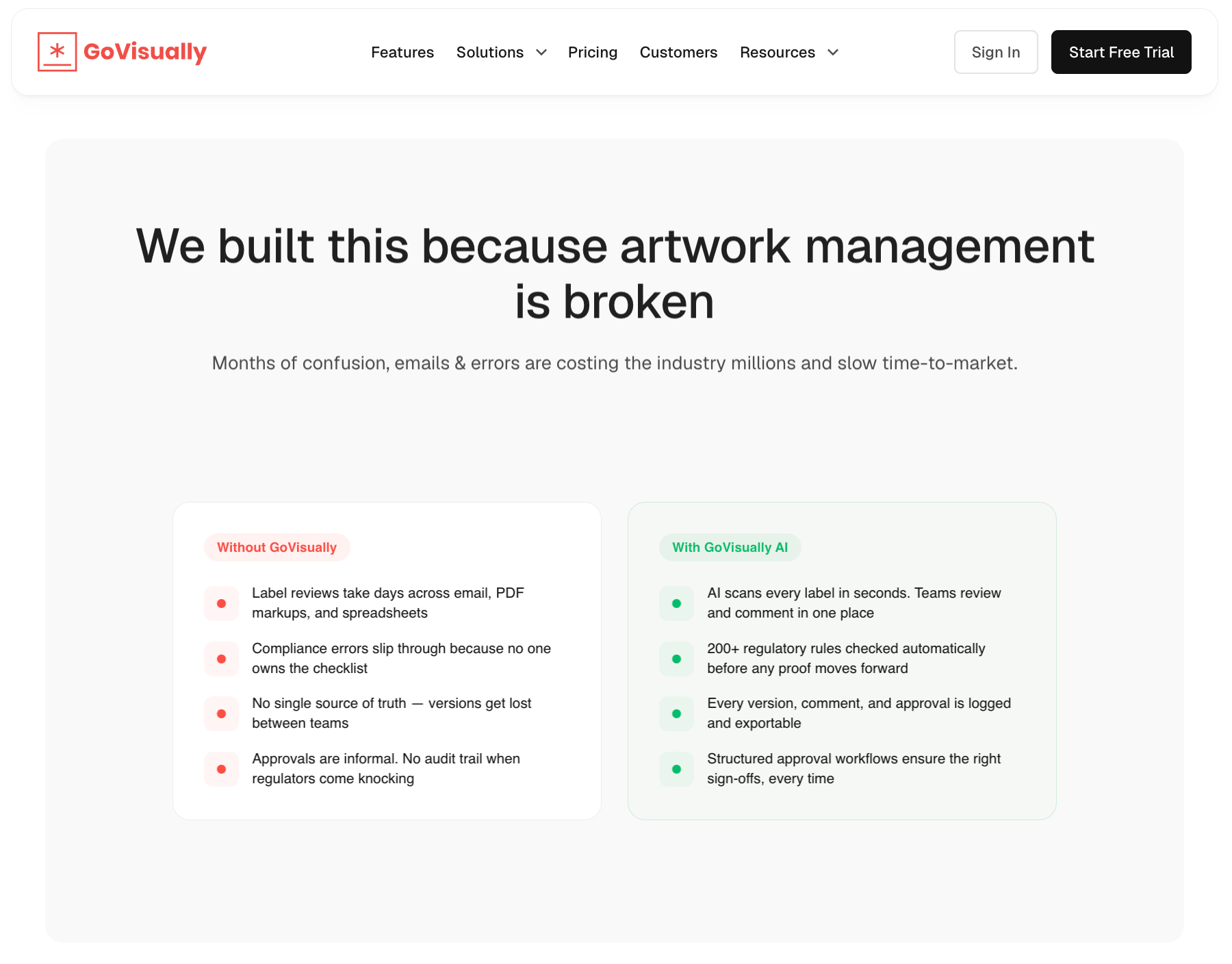
Navigating these intricate regulations manually is a recipe for delays and errors. This is precisely where GoVisually AI becomes an indispensable partner for CPG brands. Imagine an AI assistant that:
- Scans your artwork in seconds: Instantly flags missing allergens, incorrect font sizes, or non-compliant claims, catching errors that human eyes might miss.
- Learns your rules: Adapts to your specific brand guidelines and Standard Operating Procedures (SOPs), ensuring consistency across your entire product portfolio.
- Streamlines approvals: Reduces endless email chains and manual checks, accelerating your time-to-market by up to 80%.
- Provides an auditable trail: Every change, comment, and approval is meticulously recorded, providing an ironclad defense during regulatory audits.
GoVisually AI transforms compliance from a daunting, time-consuming burden into a seamless, automated process. It empowers your creative and marketing teams to innovate faster, knowing that their designs are rigorously checked against the latest FDA and USDA mandates. This isn't just about avoiding penalties; it's about launching with confidence, protecting your brand, and dominating the shelf.
Building a Scalable Food Label Compliance Process for Your Brand
For CPG brands, a deep understanding of US food labeling regulations is paramount. From the foundational requirements of the FDA and USDA to the critical nuances of allergen declarations and technical specifications, every detail matters. The era of manual, error-prone compliance is over. By embracing AI-powered solutions like GoVisually AI, brands can not only meet but exceed regulatory expectations, turning compliance into a powerful competitive advantage. Launch faster, safer, and with the unwavering certainty that your products are perfectly poised for success on the American shelf.
Book a demo with GoVisually to see how our AI-powered label review tools can help your team navigate FDA labeling with confidence.