
GoVisually AI vs Taama (formerly Sieve): AI Compliance Platforms Compared for CPG

Your product is ready. Your global expansion plan is set. But then, the "Market Entry Wall" hits. A major retailer like Whole Foods rejects your SKU because of a minor spec violation, or the EFSA flags your label for a claim that was perfectly fine in the US. Your international launch date just moved from "next week" to "next quarter," and your revenue forecast is in freefall.
Scaling a CPG brand globally isn't just about good design; it’s about surviving a minefield of shifting regulations and hyper-specific retailer requirements. You need packaging compliance automation that doesn't just proofread, but strategically guides your market entry. But is your priority fixing the creative bottleneck, or ensuring you never get kicked back by a retailer again?
We’re comparing the lightning-fast, collaborative "AI Magic" of GoVisually AI against the global, retailer-focused intelligence of Taama (formerly Sieve). This isn't just a feature comparison—it’s a roadmap for choosing the label compliance software that will actually let you scale without the chaos. If you're ready to stop launch delays before they hit your revenue, let’s dive in.
GoVisually AI vs Taama at a Glance
Before diving into the granular details of their compliance features, it is essential to understand the core philosophy driving each platform.
GoVisually AI is built around the concept of speed and collaborative agility. It leverages its proprietary GIA AI to automate label reviews, transforming a process that traditionally took weeks into a matter of seconds.
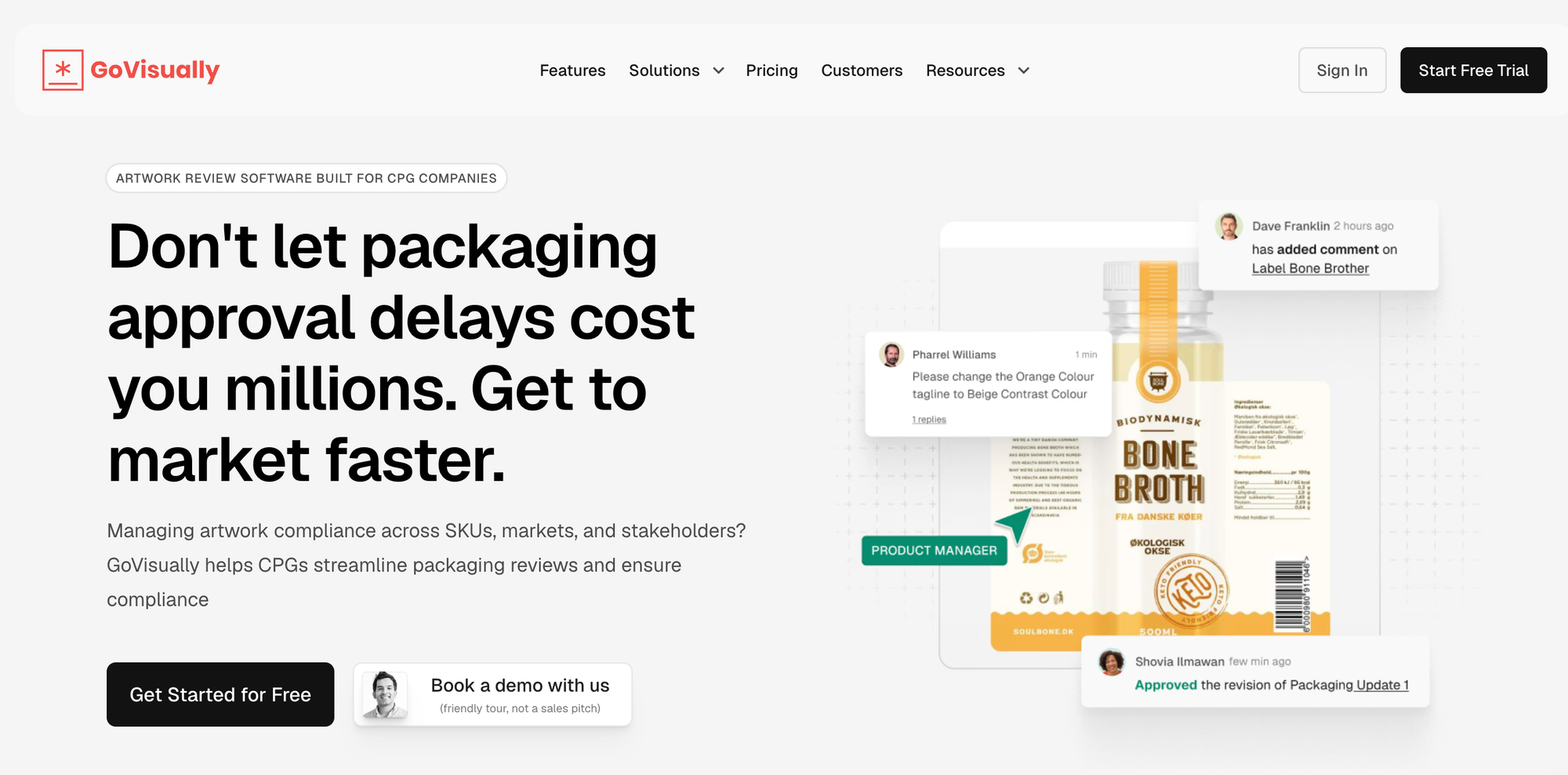
The platform is designed to catch compliance issues—such as FDA regulations, allergen statements, and brand guideline violations—before they ever reach the printing stage. It is a tool built for modern marketing and creative teams who need to move fast without sacrificing accuracy.
Taama (formerly Sieve), on the other hand, positions itself as an AI-powered food regulatory compliance platform for global CPG brands.
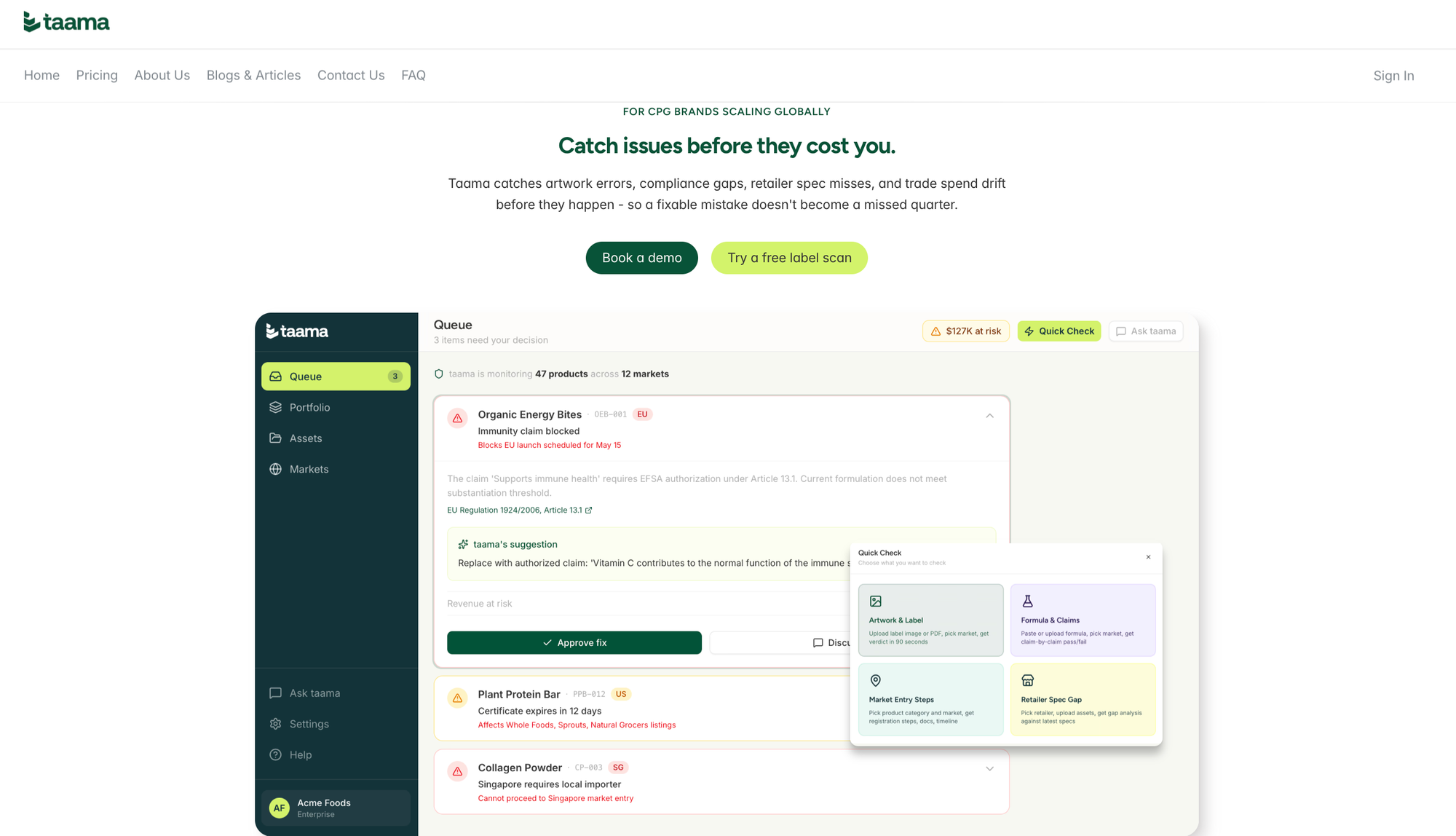
Its focus extends beyond just label proofing to encompass the entire market entry process, including global regulatory adherence, retailer specifications, and even post-launch trade spend monitoring. Taama is designed for brands scaling globally, aiming to prevent product launch delays and ensure continuous compliance across diverse markets.
| Feature Category | GoVisually AI | Taama (formerly Sieve) |
|---|---|---|
| Primary Focus | Speed, Collaboration, Creative Workflow | Global Regulatory & Retailer Readiness |
| Target Audience | Marketing, Brand Managers, Agencies | Regulatory Affairs, Sales, Supply Chain |
| AI Compliance Engine | GIA AI (Label scanning & Chat) | Proprietary AI for Global Regs & Specs |
| Compliance Scope | FDA, EU, Allergen, Brand Guidelines | FDA, EFSA, SFA, FSANZ, Retailer Specs |
| Post-Launch Features | Archive search, custom fields | Trade spend monitoring, margin drift alerts |
| Design Integration | Adobe CC, Slack, Asana | Portfolio monitoring, Retailer dashboards |
Main Features of AI Compliance Software
A robust AI compliance tool plays a pivotal role in streamlining the packaging approval process and ensuring regulatory adherence.
The cost of a product recall due to a mislabeled allergen or an incorrect nutritional claim can run into the millions, not to mention the irreparable damage to brand trust. Here are the key features to look for when evaluating such a tool:
- Automated Regulatory Checks: The ability to instantly scan artwork against global databases (FDA, EU, USDA, EFSA, FSANZ, SFA) to ensure all mandatory claims and warnings are present and accurate.
- Print Error Detection: Advanced algorithms that identify pixel-level discrepancies, color shifts, and formatting errors between the approved digital file and the final print proof.
- Allergen and Ingredient Verification: Automated cross-referencing of ingredient lists against known allergen databases to prevent life-threatening omissions.
- Barcode and QR Code Grading: Built-in tools to verify that all scannable codes meet ISO and ANSI standards, ensuring they function correctly at the point of sale.
- Version Control and Audit Trails: Comprehensive tracking of every change, comment, and approval, providing a secure historical record for regulatory audits.
- Contextual Spelling and Grammar: AI that understands industry-specific terminology and catches contextual errors that standard spell-checkers miss.
- Custom Brand Guidelines: The ability to train the AI on specific brand rules, ensuring consistency across all product lines and global markets.
- Retailer Specification Compliance: Automated verification against specific retailer packaging and labeling requirements.
- Continuous Regulatory Monitoring: Proactive alerts for changes in global food regulations and market developments.
Detailed Feature Comparison: GoVisually AI vs Taama
When it comes to AI compliance for CPG, both platforms offer powerful solutions, but their approaches and strengths differ significantly. Let us break down their capabilities across key compliance categories to see how they stack up against each other.
Automated Label Compliance
Ensuring that a label meets all regulatory requirements is the most critical step in the packaging process. A failure here can result in massive fines, product recalls, and severe damage to brand reputation. The sheer volume of regulations—which vary by country and product category—makes manual review a high-risk endeavor.
GoVisually AI
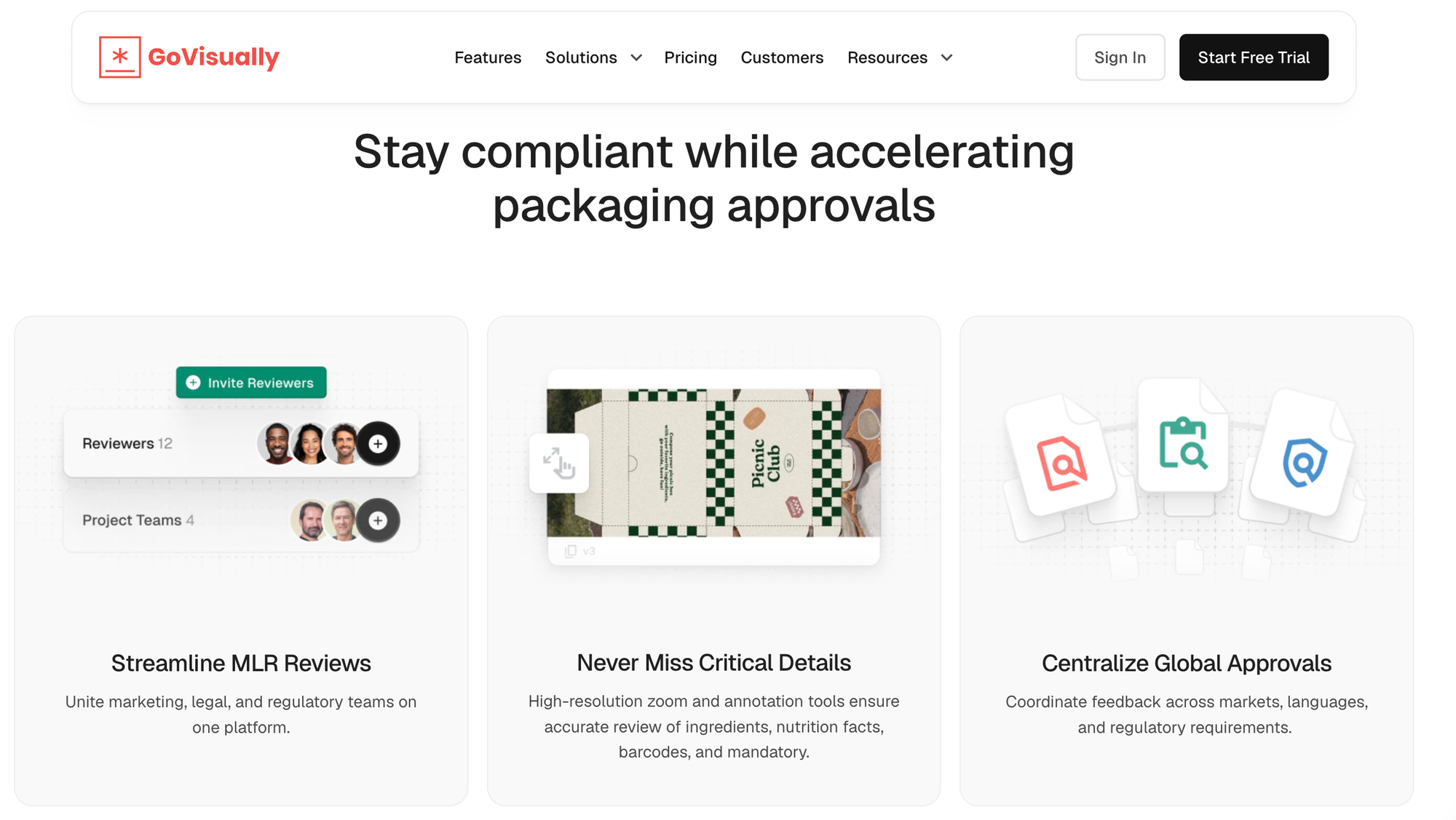
GoVisually AI approaches label compliance software with a focus on speed and user-friendly automation. The platform utilizes "AI Playbooks," which allow teams to set their compliance rules once. Upon uploading a new label design, the AI instantly scans the document against these predefined rules, delivering a comprehensive report in under 30 seconds. This rapid feedback loop is invaluable for creative teams.
The system automatically verifies FDA nutrition panel requirements, EU Regulation 1169/2011, and FALCPA allergen declarations. It also checks for USDA Organic claims and net quantity statements. One of the standout features is the AI Chat, which understands the context of your specific products.
For example, a user can ask the AI to check all protein bar labels for new FDA guidance on fiber claims, and the system will scan the approved files and provide actionable insights. This level of conversational AI makes GoVisually highly accessible for non-technical team members, empowering marketing and design teams to catch errors before they ever reach the legal department.
Furthermore, GoVisually AI learns from your specific Standard Operating Procedures (SOPs). By uploading your compliance documents and brand guidelines, the AI becomes smarter with every use, adapting to the unique nuances of your product portfolio. This ensures that internal brand consistency is maintained alongside external regulatory adherence.
Taama (formerly Sieve)
Taama’s approach to global food regulations AI is more expansive, focusing on the entire product lifecycle from concept to market.
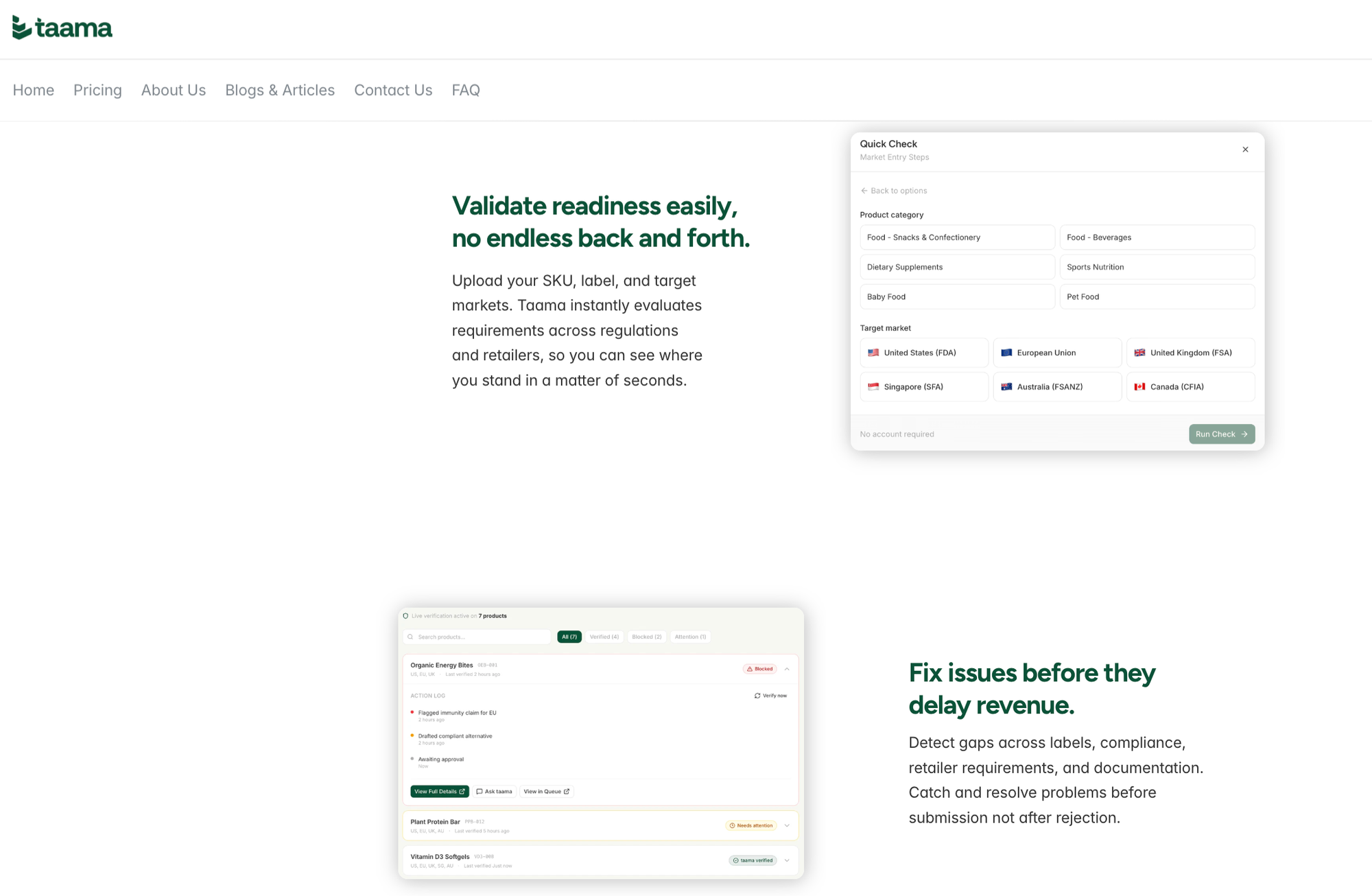
It acts as a comprehensive co-pilot, validating claims against complex global regulations including FDA, EFSA (European Food Safety Authority), SFA (Singapore Food Agency), and FSANZ (Food Standards Australia New Zealand). Where GoVisually focuses on the creative workflow, Taama is built for the heavy lifting of regulatory affairs and market entry.
Taama excels at ensuring the presence of mandatory warning statements and verifying the consistency of nutritional information between the Front of Pack (FoP) and Back of Pack (BoP). It is particularly adept at detecting contextual spelling mistakes in critical label information and confirming the presence of mandatory legal elements like net weight and ingredient lists. Taama’s strength lies in its ability to unify global labeling rules with custom brand standards, making it an ideal solution for multinational CPG brands managing thousands of SKUs across different regulatory environments.
The platform is designed to handle the complexity of highly regulated food and beverage markets, where compliance is not just a marketing preference but a strict legal mandate. It provides a centralized dashboard for CPG launch readiness, allowing teams to track compliance status across all products and markets.
Verdict
For teams prioritizing speed, ease of use, and collaborative AI features within the creative and design phases, GoVisually AI is the superior choice. Its AI Playbooks and conversational interface make label compliance accessible to marketing and design teams, drastically reducing the back-and-forth between departments. However, for enterprise-level CPG brands that require deep, rigorous validation across complex global markets, including specific regional and retailer requirements, Taama offers the exhaustive oversight necessary to guarantee compliance at scale and ensure smooth market entry.
Print Error Detection and Quality Assurance
Even if a label is perfectly compliant in its digital form, errors during the printing process can lead to disastrous consequences. A shifted decimal point in a nutritional panel or a misprinted barcode can render a product unsellable. Detecting these errors before mass production is essential for preventing print error detection related compliance violations.
GoVisually AI
GoVisually AI includes print-readiness validation as part of its automated scanning process. It checks for basic formatting issues, color shifts, and layout adjustments. The platform’s visual comparison tool allows users to overlay two versions of a file or view them side-by-side, highlighting exactly what has changed between iterations. This is crucial for ensuring that design changes are accurately implemented and that the final artwork matches the approved concept.
While this is highly effective for catching design inconsistencies and ensuring that the final file matches the approved concept, it is primarily focused on the digital review stage. It is an excellent tool for designers and brand managers to verify that their intended changes were made, but it does not offer the deep, technical print inspection capabilities required by prepress and production teams for physical print quality assurance.
Taama (formerly Sieve)
Taama's primary focus is on regulatory and retailer compliance, rather than deep print quality inspection. While it ensures that all necessary elements are present and correctly formatted on the label for compliance, its core strength is not in pixel-to-pixel print error detection or advanced print quality assurance features like barcode grading or braille inspection. Taama's strength lies in verifying the content and structure of the label against regulatory and retailer requirements, rather than the physical fidelity of the print.
Verdict
For comprehensive print error detection and quality assurance, neither GoVisually AI nor Taama are specialized tools in the same vein as dedicated print inspection software (like GlobalVision, as discussed in a previous comparison). GoVisually AI offers visual comparison for design changes, which helps catch some print-related errors in the digital proofing stage. Taama focuses on content and structural compliance. CPG brands with stringent print quality requirements might need to integrate either of these platforms with a specialized print inspection solution.
Preventing Compliance Violations
The ultimate goal of any compliance software is to prevent violations that lead to product recalls. A recall not only costs millions in logistics and lost sales but can also permanently damage consumer trust. Both platforms approach this goal from different angles, targeting different stages of the product lifecycle.
GoVisually AI
GoVisually AI prevents compliance violations by integrating the checking process directly into the creative workflow. By catching errors in the initial design phase—such as an invalid "Low Fat" claim or a missing RSPO certification warning for palm oil—the platform ensures that non-compliant designs never advance to the approval stage. This proactive approach significantly reduces the risk of costly errors reaching the market.
The system’s structured approval workflows guarantee that the right stakeholders (e.g., legal and brand teams) sign off on the artwork, creating a clear audit trail. This prevents bottlenecks and ensures accountability. If the AI catches a missing allergen warning in version one, the designer can fix it immediately, rather than waiting weeks for the legal team to flag the issue. This drastically reduces the number of revision cycles and accelerates time-to-market, a critical factor for competitive CPG brands.
Taama (formerly Sieve)
Taama prevents violations by acting as a comprehensive gatekeeper for market entry and ongoing compliance. Its platform is trusted throughout the entire product lifecycle, from initial formulation to post-launch monitoring. By providing automated checks against global food regulations AI and retailer spec verification, Taama ensures that products are compliant not just with government laws but also with the specific requirements of each sales channel.
Its ability to monitor regulatory changes and market developments proactively means that brands are alerted to potential issues before they become violations. For example, if a new FDA regulation impacts an existing product, Taama will flag it, allowing the brand to make necessary adjustments. This continuous monitoring is crucial for brands operating in multiple international markets, where regulations are constantly evolving.
Verdict
Both platforms are highly effective at preventing compliance violations, but they serve different stages of the lifecycle. GoVisually AI is best for preventing errors during the creative and design phases, empowering marketing teams to work faster and smarter. Taama is the ultimate safety net for market entry and ongoing global compliance, providing the rigorous checks needed by regulatory and sales teams to avoid delays and ensure continuous adherence to diverse requirements.
Integration and Ecosystem
A compliance tool is only as good as its ability to fit into your existing workflow. If a tool requires your team to abandon their current processes, adoption will be slow and painful.
GoVisually AI
GoVisually AI is designed to play nicely with the tools modern creative teams already use. It offers seamless integration with Adobe Creative Cloud, allowing designers to receive feedback and compliance warnings directly within Illustrator or InDesign. It also integrates with project management tools like Asana and communication platforms like Slack, ensuring that everyone is notified the moment an approval is needed or a compliance issue is flagged. With over 3000 integrations available via Zapier, GoVisually AI can fit into almost any marketing tech stack, making it a flexible solution for diverse creative workflows.
Taama (formerly Sieve)
Taama is built for the enterprise, focusing on integrating with the broader CPG ecosystem. While specific integration partners are not explicitly detailed on their public site, their emphasis on CPG launch readiness and continuous monitoring suggests integration with PLM (Product Lifecycle Management) systems, ERP (Enterprise Resource Planning) platforms, and potentially data analytics tools. Their platform provides a centralized view for managing SKUs across markets, implying robust data exchange capabilities with internal systems. Taama's strength lies in providing a holistic view of compliance and market performance, which often requires deeper, more complex integrations than creative workflow tools.
Verdict
GoVisually AI wins on ease of integration for creative and marketing teams, offering native connections to the tools they use daily. Taama, while less explicit about specific integrations, is positioned for deeper, enterprise-level data integration to support global market entry and ongoing performance monitoring.
The Cost of Manual Review in 2026
To truly understand the value of these platforms, it is important to consider the alternative: manual review. In 2026, relying on human eyes to verify complex regulatory requirements across hundreds of SKUs and dozens of markets is not just inefficient; it is dangerous. The landscape of packaging compliance automation is no longer a luxury but a necessity.
Manual reviews typically involve routing PDFs via email, tracking changes in spreadsheets, and relying on individuals to cross-reference artwork against massive regulatory databases and ever-changing retailer specifications. This process is prone to fatigue, oversight, and miscommunication. A single missed allergen warning can lead to a Class I recall, costing a company millions of dollars and exposing them to severe legal liability. Furthermore, a failure to meet a specific retailer's packaging dimension or labeling requirement can result in product rejection at the distribution center, leading to significant logistical costs and lost sales opportunities.
Moreover, manual reviews are incredibly slow. They create massive bottlenecks that delay product launches and stifle innovation. By implementing packaging compliance automation, brands can reduce their review cycles by up to 80%, freeing up their teams to focus on strategy and growth rather than tedious, error-prone proofreading. The speed and accuracy offered by AI platforms directly translate into faster time-to-market and increased revenue potential.
Which Tool Should Your CPG Brand Choose?
The decision between GoVisually AI and Taama ultimately depends on your team's structure, your primary pain points, and the regulatory complexity of your products and target markets.
Choose GoVisually AI if:
- You are a marketing director, brand manager, or creative agency looking to drastically reduce approval times for packaging artwork.
- Your primary bottleneck is the back-and-forth communication and manual checks during the design and creative proofing phase.
- You want an intuitive, conversational AI tool that can quickly scan for FDA, EU, and allergen compliance, as well as internal brand guidelines.
- You prioritize a seamless, collaborative user interface that integrates easily with your existing project management and creative tools like Adobe Creative Cloud, Slack, and Asana.
- You want to empower your design team to catch compliance errors proactively, minimizing legal review cycles.
Choose Taama (formerly Sieve) if:
- You are a regulatory affairs specialist, sales manager, or supply chain professional managing global product launches.
- Your primary concern is ensuring comprehensive compliance across multiple international markets, including diverse government regulations (FDA, EFSA, SFA, FSANZ).
- You need automated retailer spec verification to avoid costly rejections from major retail partners.
- You require continuous monitoring of regulatory changes and market developments to proactively adapt your product portfolio.
- You are looking for a platform that also provides insights into trade spend monitoring and margin drift post-launch, offering a broader view of product performance.
- You manage a large and complex portfolio of SKUs across various global regions and need a centralized system for CPG launch readiness.
Frequently Asked Questions (FAQs)
What are the main differences between GoVisually AI and Taama?
GoVisually AI excels in accelerating the creative proofing process with AI-powered label scanning for regulatory and brand guideline compliance. Taama, on the other hand, offers a broader AI compliance for CPG solution, focusing on global regulatory adherence, retailer specification verification, and post-launch financial monitoring to ensure market entry success and ongoing profitability.
Which tool is better for global expansion?
Taama is explicitly designed for global food regulations AI and market expansion. Its comprehensive checks against international regulations (EFSA, SFA, FSANZ) and retailer specifications make it the stronger choice for brands looking to scale across diverse international markets.
Does Taama handle artwork proofing like GoVisually?
While Taama verifies the compliance of label content and structure, its primary function is not collaborative artwork proofing in the same way GoVisually AI operates. GoVisually AI provides visual comparison and annotation tools for design iterations, which is its core strength in the creative workflow.
How does Taama's retailer spec verification work?
Taama automates the process of checking your packaging artwork and documentation against the specific requirements of various retailers. This includes aspects like barcode placement, nutritional panel formats, ingredient list order, and even specific claims allowed or disallowed by a particular retail chain, helping to prevent costly rejections at the distribution center.
Which tool should a startup CPG brand choose?
A startup CPG brand might find GoVisually AI more immediately beneficial for streamlining their initial design and approval processes, especially if their focus is on a single market. However, if global aspirations are central to their business model from day one, Taama's comprehensive market entry features could be a strategic investment.
Can I use both tools together in my workflow?
Yes, for some CPG brands, a hybrid approach might be optimal. GoVisually AI could manage the initial creative proofing and internal brand compliance, ensuring designs are polished and internally approved. Taama could then act as the final gatekeeper for market-specific regulatory and retailer compliance before launch, and for ongoing monitoring. This leverages the strengths of both platforms.
Conclusion
In the dynamic world of CPG, choosing the right packaging compliance automation platform is a strategic decision that impacts everything from speed-to-market to brand reputation. The choice between GoVisually AI vs Taama (formerly Sieve) hinges on your brand's specific needs and priorities.
If your goal is to empower your creative teams, accelerate design approvals, and ensure internal brand and basic regulatory compliance with an intuitive, collaborative platform, GoVisually AI offers unparalleled "AI Magic." It's the ideal solution for streamlining the creative workflow and catching errors early in the design phase.
However, if your brand is focused on aggressive global expansion, navigating complex international food regulations, adhering to stringent retailer spec verification, and monitoring the financial health of your products post-launch, Taama provides a comprehensive, enterprise-grade solution. It's built to ensure CPG launch readiness and continuous compliance across a diverse and evolving global marketplace.
By carefully evaluating your workflow, your team structure, and your compliance requirements, you can select the label compliance software that will protect your brand, streamline your operations, and ensure your products reach the market safely and profitably in 2026 and beyond.