
Sustainability Claims on Packaging: Legal Requirements & Greenwashing Risks in 2026


Disclaimer: While GoVisually strives to convey accurate information, please refer to the relevant official website for the most up-to-date guidelines on food, safety, and labeling.
The End of the "Eco-Vague" Era: Why 2026 is the Year of Enforcement
For Consumer Packaged Goods (CPG) brands, the era of vague, unsubstantiated "eco-friendly" claims on packaging is rapidly drawing to a close. As consumer awareness of environmental issues grows, so does regulatory scrutiny. 2026 marks a pivotal year where new legislation and stricter enforcement across the EU, UK, and US will fundamentally reshape how sustainability claims can be made. Brands that fail to adapt risk not only hefty fines but also severe reputational damage from accusations of greenwashing.
What is Greenwashing?
Greenwashing is the practice of making an unsubstantiated or misleading claim about the environmental benefits of a product, service, technology, or company practice. It misleads consumers into believing that a company or product is more environmentally sound than it actually is.
Worried about greenwashing accusations? Start your free trial with GoVisually to ensure your sustainability claims are accurate and compliant.
The EU’s New "Greenwashing Directive" (ECGT): What’s Already Banned
While the much-discussed EU Green Claims Directive (GCD) has been effectively paused or withdrawn as of June 2025, a critical piece of legislation is already law and set for enforcement: the Empowering Consumers for the Green Transition (ECGT) Directive. This directive, which entered into force in March 2024, will be enforced from September 2026 across all EU member states, significantly tightening the rules around environmental claims.
Key Prohibitions Under ECGT (Effective September 2026)
The ECGT amends the EU’s Unfair Commercial Practices Directive (UCPD) by adding several new banned practices directly impacting sustainability claims on packaging:
- Generic Environmental Claims without Proof: Terms like "environmentally friendly," "climate friendly," "green," "eco-friendly," or "biodegradable" are prohibited unless you can demonstrate outstanding, recognized environmental performance that is certified or officially recognized.
- Offset-Based Product Claims: Any claim that a product has a "neutral, reduced or positive impact in terms of greenhouse gas emissions" is flatly banned if it relies on carbon offsetting. This effectively kills product-level "climate neutral" or "CO₂ neutral" labels that are based solely on purchasing carbon credits.
- Misleading Sustainability Labels: Displaying a sustainability label that is not based on a recognized certification scheme or established by public authorities is now prohibited.
- Unsubstantiated Future Claims: Promises about future environmental performance (e.g., "net zero by 2030") must be backed by a clear, public, verifiable plan with concrete targets and regular independent monitoring.
The Importance of Substantiation
The European Commission found that 53% of green claims in the EU are vague, misleading, or unfounded, with 40% lacking supporting evidence. The ECGT aims to rectify this by demanding robust, science-based substantiation for all explicit environmental claims.
UK & US Update: The CMA’s Direct Enforcement and the FTC’s New Guides
Beyond the EU, regulators in the UK and US are also intensifying their focus on greenwashing, ensuring that brands are held accountable for their environmental claims.
UK: CMA Green Claims Code
The UK’s Competition and Markets Authority (CMA) has been actively enforcing its Green Claims Code, which provides six core principles for businesses to follow:
- Truthful and Accurate: Claims must be factually correct and not misleading.
- Clear and Unambiguous: Claims should be easily understood by the average consumer.
- No Omissions: Important information should not be hidden or left out.
- Fair Comparisons: Any comparisons must be based on clear, objective, and verifiable information.
- Consider Full Life Cycle: Claims should reflect the entire life cycle of the product or service.
- Substantiated: All claims must be supported by robust, credible, and up-to-date evidence.
The CMA is increasingly using direct enforcement powers (expected from April 2025) and has emphasized supply chain responsibility, meaning retailers can be held liable for claims made by their suppliers.
US: FTC Green Guides
The US Federal Trade Commission (FTC) is in the process of updating its Green Guides, which provide guidance on environmental marketing claims. While the updated version is expected in late 2024 or 2025, the focus remains on ensuring claims are truthful, non-deceptive, and substantiated. Key areas of scrutiny include claims related to "recyclable," "compostable," and "carbon neutral" products.
The "Climate Neutral" Trap: Why Carbon Offsets are No Longer Enough
One of the most significant shifts in regulatory thinking concerns "climate neutral" or "carbon neutral" claims, particularly when they rely on carbon offsetting. The EU’s ECGT Directive explicitly bans such product-level claims if they are based on offsets from September 2026.
The German Federal Court Ruling
This trend is further reinforced by national legal precedents. In June 2024, the German Federal Court of Justice (BGH) ruled that the term "klimaneutral" (climate neutral) is inherently ambiguous. The court found that consumers may interpret it as actual emissions reductions rather than mere offsetting. This ruling requires companies using the term to clarify its concrete meaning—reduction, compensation, or both—directly in the advertisement itself.
Implications for CPG Brands
Brands can no longer simply purchase carbon credits to label their products "climate neutral." Instead, the focus must shift to demonstrable, science-based emissions reductions throughout the product lifecycle. If offsets are used, they must be transparently disclosed, high-quality, and clearly differentiated from actual reductions.
How to Substantiate: Moving from Marketing Fluff to Science-Based Proof
With regulators demanding robust evidence, CPG brands must overhaul their approach to substantiating sustainability claims. This means moving beyond vague assertions to verifiable, data-driven proof.
Building an Audit-Ready Substantiation System
Drawing inspiration from the original (though paused) EU Green Claims Directive, effective substantiation requires:
- Life Cycle Assessment (LCA): Claims should be based on a comprehensive LCA that considers the environmental impacts across the entire product lifecycle, from raw material extraction to end-of-life.
- Science-Based Evidence: Use accurate data, recognized methodologies, and relevant global standards to back up claims.
- Transparency on Trade-offs: Disclose any trade-offs where an environmental benefit in one area might worsen another (e.g., increased recyclability leading to higher energy consumption).
- Independent Verification: Claims and labels should ideally be checked by an independent and accredited verifier to ensure credibility.
- Go Beyond Compliance: Demonstrate that the claim surpasses basic legal requirements and offers a genuine environmental benefit.
The Role of Data and Documentation
Every claim must have a "standard claim file" that includes the exact claim wording, the channel and date range of its use, and all supporting data, methodologies, and documentation. This evidence must be current (updated within the past five years) and centrally stored for easy access during audits.
Scaling Compliance with GoVisually: Ensuring Every Claim is Verified
The increasing complexity of global sustainability regulations, coupled with the need for rigorous substantiation, presents a significant challenge for CPG brands. Managing countless claims, design iterations, and legal reviews manually is inefficient and prone to error. This is where GoVisually becomes an indispensable tool.
How GoVisually Transforms Your Compliance Workflow?
GoVisually provides a centralized platform that streamlines the entire packaging and marketing review process, ensuring your sustainability claims are not only creative but also compliant
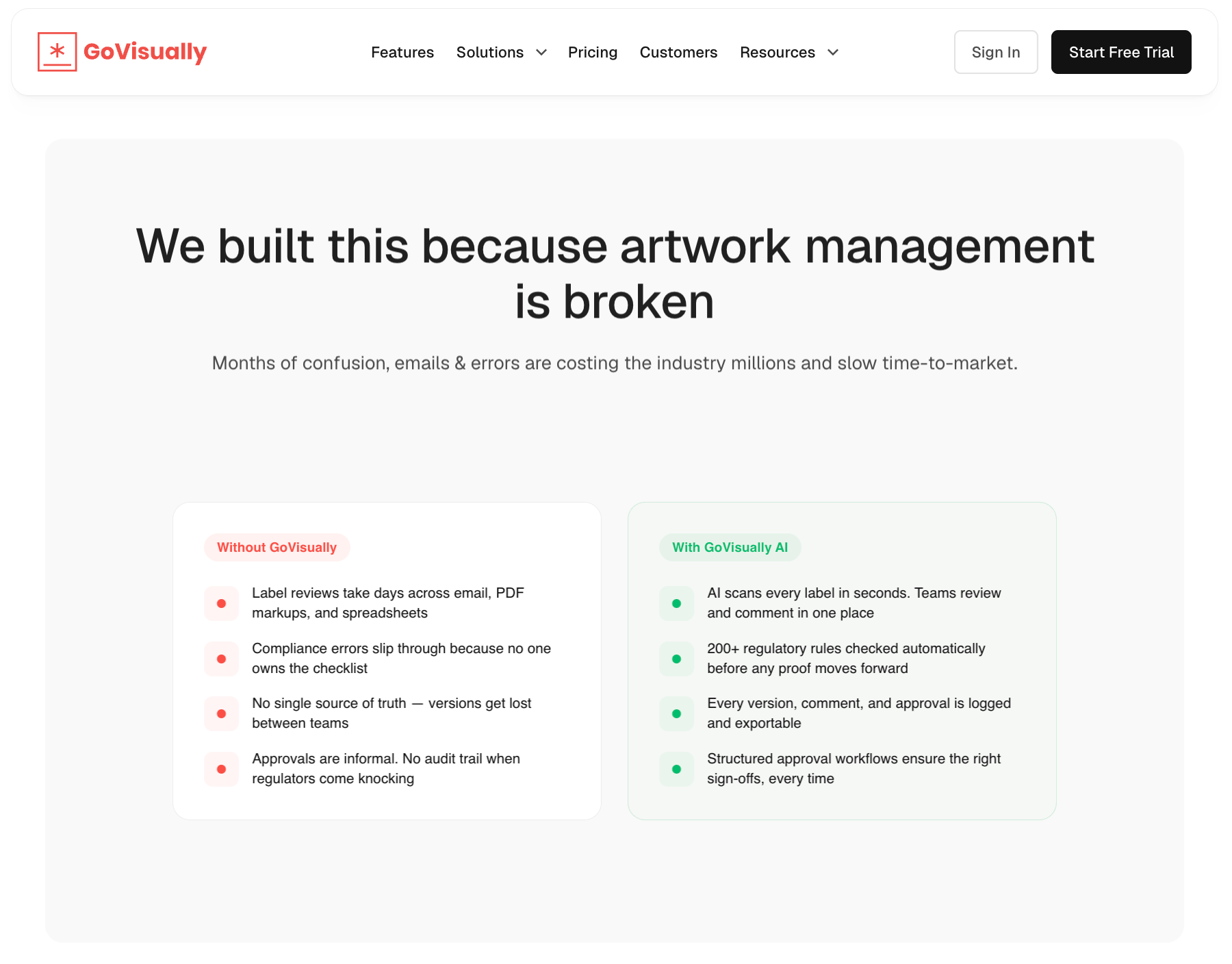
- Centralized Feedback & Annotation: Legal and sustainability teams can annotate directly on packaging artwork, highlighting specific claims, suggesting edits, and ensuring all required disclosures are present. This eliminates endless email chains and ensures clarity.
- Version Control & Audit Trails: Every iteration of your packaging design and every piece of feedback is automatically logged. This creates an immutable audit trail that is crucial for demonstrating due diligence to regulators like the CMA or FTC.
- Accelerated Approvals: By bringing all stakeholders—design, marketing, legal, and compliance—into a single, collaborative environment, GoVisually significantly reduces approval cycles. This means your products can get to market faster, confident that their sustainability claims are watertight.
- Risk Mitigation: Proactive identification and correction of potentially misleading claims before printing can save brands from costly recalls, fines, and reputational damage associated with greenwashing.
In a world where consumers and regulators demand transparency and accuracy, leveraging a robust review and approval platform like GoVisually isn't just a best practice—it's a strategic imperative for any CPG brand committed to genuine sustainability.
Ready to future-proof your sustainability claims? Book a demo with GoVisually and see how leading brands manage compliance with confidence.
FAQ: Your Quick Guide to Sustainability Claims & Greenwashing
What is the EU ECGT Directive?
The Empowering Consumers for the Green Transition (ECGT) Directive is an EU law that bans generic green claims and offset-based "climate neutral" product claims from September 2026, among other misleading practices.
Is the EU Green Claims Directive (GCD) still active?
No, the EU Green Claims Directive (GCD) has been effectively paused or withdrawn. However, its principles for robust substantiation remain a benchmark for best practice.
What are the UK CMA Green Claims Code principles?
The CMA Green Claims Code requires claims to be truthful, clear, not omit important information, make fair comparisons, consider the full life cycle, and be substantiated by evidence.
Can I still use "climate neutral" on my packaging?
In the EU, product-level "climate neutral" claims based on carbon offsets will be banned from September 2026. In other regions, such claims require rigorous, transparent substantiation, often including clarification of actual reductions versus offsets.
How does GoVisually help prevent greenwashing?
GoVisually provides a centralized platform for legal and marketing teams to review and approve packaging artwork. Its features, like precise annotation and audit trails, ensure that all sustainability claims are accurately substantiated and compliant before going to print, significantly reducing greenwashing risks.