
UK Food Labelling After Brexit: The Ultimate 2026 Compliance Guide for CPG Brands

Disclaimer: While GoVisually strives to convey accurate information, please refer to the official website of FSAI for the most up-to-date guidelines on food and safety and labeling.
For Consumer Packaged Goods (CPG) brands, the UK's departure from the European Union has ushered in a complex and evolving regulatory environment for food labelling. What began as a period of "retained EU law" is now transitioning towards a distinct UK national food regulation system. Understanding these shifts, particularly the nuances introduced by the Windsor Framework and ongoing legislative developments, is critical for maintaining compliance and market access in 2026 and beyond.
The Shifting Sands of UK Food Law
The UK's Food Standards Agency (FSA) and Food Standards Scotland (FSS) are the primary authorities governing food standards. While much of the initial post-Brexit legislation mirrored EU law, the UK is increasingly forging its own path. This guide will help CPG brands navigate the complexities, from the specific requirements of the Windsor Framework to broader regulatory trends.
The Windsor Framework in 2026: Green Lane vs. Red Lane
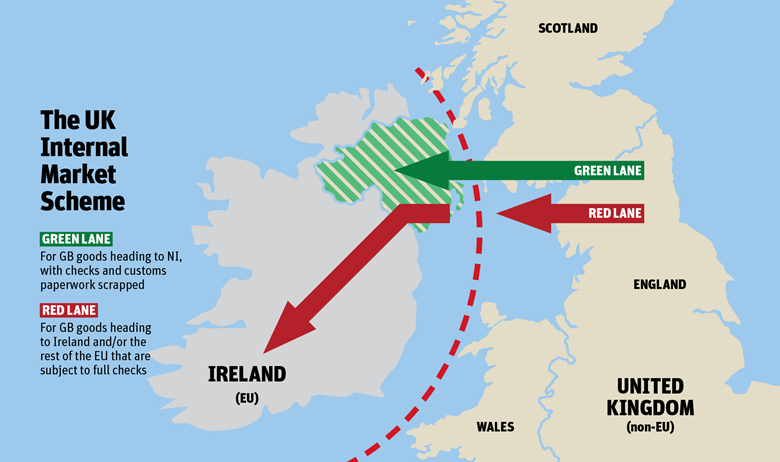
The Windsor Framework, which replaced the Northern Ireland Protocol, is central to understanding food movements between Great Britain (GB) and Northern Ireland (NI). It established a dual-lane system to manage goods, aiming to safeguard NI's place in the UK internal market while respecting its unique position with the EU single market.
Understanding the Dual-Lane System
- Green Lane (Northern Ireland Retail Movement Scheme - NIRMS): This lane is for goods destined for consumption within Northern Ireland and deemed "not at risk" of entering the EU. It offers simplified paperwork and checks compared to the Red Lane.
- Red Lane: This lane is for goods moving into Northern Ireland that are destined for the Republic of Irela nd or elsewhere in the EU. These shipments require full customs declarations, including commodity codes and safety and security declarations, and may be subject to EU tariffs.
Key Dates for Windsor Framework Labelling
| Phase | Effective Date | Products Covered | Labelling Requirement |
|---|---|---|---|
| Phase 1 | October 2023 | Meat and some dairy products | "Not for EU" individual labelling |
| Phase 2 | October 1, 2024 | All milk and dairy products | "Not for EU" individual labelling |
| Phase 3 | July 1, 2025 | Composite products, unprocessed fruits & vegetables, fish, eggs, honey, and pet food | "Not for EU" individual labelling |
Struggling to keep up with changing labels regulations? See how GoVisually can streamline your compliance review process today.
"Not for EU" Labelling: What’s Mandatory and What’s Not?
The "Not for EU" label is a critical component of the Windsor Framework, designed to ensure goods moving through the Green Lane remain within the UK internal market. However, its application has specific geographical limitations.
Mandatory for Northern Ireland (NI)
- As per the Windsor Framework, "Not for EU" individual labelling is fully mandatory for certain goods entering Northern Ireland via the Green Lane, according to the phased implementation dates outlined above.
- This ensures that products benefiting from simplified GB-NI movement are clearly identified as not intended for the EU market.
Not Mandatory for Great Britain (GB) – For Now
- The UK Government confirmed on September 30, 2024 that it would not proceed with mandatory "Not for EU" labelling for goods sold within Great Britain (England, Scotland, Wales).
- This decision was made after consultation with businesses, though the government may revisit this in the future if necessary to monitor the supply of agri-foods into Northern Ireland.
Expert Clarification
Mabel Hove, Specifications Technologist at NSF, emphasizes that the "Not for EU" label does not imply a lower standard of food safety. Instead, it serves as a control mechanism for goods movement, ensuring compliance with the framework's intent.
Don't let label changes slow you down. Book a demo with GoVisually to see how top CPG brands manage regulatory updates in real-time.
Data Hygiene: Why "Gifts" and "Samples" Will Get Your Shipment Rejected
Beyond the physical labels, the accuracy and detail of accompanying data are paramount for smooth cross-border trade, particularly for shipments to Northern Ireland. The grace period for vague product descriptions is over.
The Importance of Detailed Descriptions
- Logistics providers like Landmark Global warn that in 2026, vague descriptions such as "Gifts," "Parts," or "Samples" are causing immediate rejections.
- To ensure Green Lane access, shipping software must provide detailed descriptions (e.g., "Men's Cotton Shirt" instead of "Clothing"), accurate weights (gross and net per item), and the true transaction value.
UKIMS Authorization for B2B Shipments
For businesses moving goods Business-to-Business (B2B) via the Green Lane, a valid UK Internal Market Scheme (UKIMS) authorization is essential. Without it, B2B shipments will default to the Red Lane, incurring full customs declarations and potential tariffs.
The 2026 Roadmap: SPS Negotiations and National FSA Reform

Beyond the immediate concerns of the Windsor Framework, several broader regulatory shifts are underway that will impact UK food labelling.
UK-EU Sanitary and Phytosanitary (SPS) Agreement
- Crucial Negotiations: 2026 is a critical year for UK-EU negotiations on a Sanitary and Phytosanitary (SPS) agreement, aimed at reducing trade friction for agricultural products.
- Dynamic Alignment: If an agreement is reached, the UK may be required to dynamically align with EU regulations on food safety standards, impacting future labelling requirements.
National Food Regulation System by FSA
- Shift in Oversight: The FSA has been tasked with developing a new national-level food regulation system for large food businesses in England. This system, proposed to the FSA board in March 2026, will move away from solely local authority inspections towards a data-driven national scrutiny of large companies.
- Focus on Data: This reform aims to identify and address food safety risks more quickly across entire businesses, reducing administrative burdens while maintaining public health protection.
Mandatory Health Reporting Consultation
- UK-Wide Initiative: A UK-wide consultation on mandatory health reporting for all major food companies is expected in March 2026.
- HFSS Impact: This could lead to significant changes for products classified as High Fat, Salt, or Sugar (HFSS), potentially requiring reformulation or new labelling approaches, though any legislation is not expected before 2029.
Cell-Cultivated Products and PFAS
- Emerging Foods: The FSA's regulatory sandbox program (2025-2027) is actively developing safety and labelling guidance for cell-cultivated products.
- EU Chemical Bans: For brands exporting to the EU, it's crucial to note the EU's ban on PFAS in food contact materials from August 2026, and ongoing restrictions on substances like Bisphenol A (BPA).
Scaling Compliance: How GoVisually Simplifies the Post-Brexit Scramble
The complexity of post-Brexit food labelling—managing different rules for GB, NI, and the EU—makes manual compliance processes a significant bottleneck for CPG brands. This is where GoVisually transforms the workflow.
Why Top CPG Brands Choose GoVisually?
As regulatory landscapes shift, the biggest risk isn't just the law—it's the communication breakdown during the review process. GoVisually acts as the central hub for your compliance and creative teams:
- Version Control & Audit Trails: Stop digging through email threads. GoVisually maintains a comprehensive, immutable record of every label version, comment, and approval—essential for demonstrating due diligence during regulatory audits.
- Precision Annotation: Compliance officers can mark up specific regulatory text or allergen declarations directly on the artwork, ensuring that every "Not for EU" label or HFSS declaration is placed with 100% accuracy.
- Cross-Functional Speed: By consolidating feedback from legal, marketing, and design in one place, GoVisually helps brands navigate the "Green Lane" of product launches, reducing time-to-market while mitigating the risk of costly recalls.
In a post-Brexit world where a single vague description or missing label can halt a shipment, having a centralized, transparent review process isn't just a luxury—it's a competitive necessity.
Ready to automate your label approvals? Get started with GoVisually and ensure your brand stays compliant across every border.
FAQ: Your Quick Guide to UK Food Labelling After Brexit
What is the Windsor Framework?
The Windsor Framework is an agreement between the UK and the EU that replaced the Northern Ireland Protocol, aiming to streamline the movement of goods between Great Britain and Northern Ireland while respecting NI's position in both the UK internal market and the EU single market.
Is "Not for EU" labelling required for all food products in the UK?
No. "Not for EU" labelling is specifically required for certain agri-food products moving from Great Britain into Northern Ireland under the Green Lane of the Windsor Framework. The UK Government has currently paused plans for mandatory "Not for EU" labelling for goods sold within Great Britain.
What are the key dates for "Not for EU" labelling under the Windsor Framework?
Phase 2, covering all milk and dairy products, became mandatory on October 1, 2024. Phase 3, which includes composite products, unprocessed fruits & vegetables, fish, eggs, honey, and pet food, becomes mandatory on July 1, 2025.
How does the FSA's new national regulation system impact large food businesses?
The FSA is developing a new system for large food businesses in England, shifting from solely local authority inspections to a data-driven national oversight. This aims to identify and address food safety risks more efficiently across entire businesses.
Where can I find official guidance on UK food labelling?
The official source for UK food labelling guidance is the Food Standards Agency (FSA) website and Gov.uk for specific Windsor Framework details.